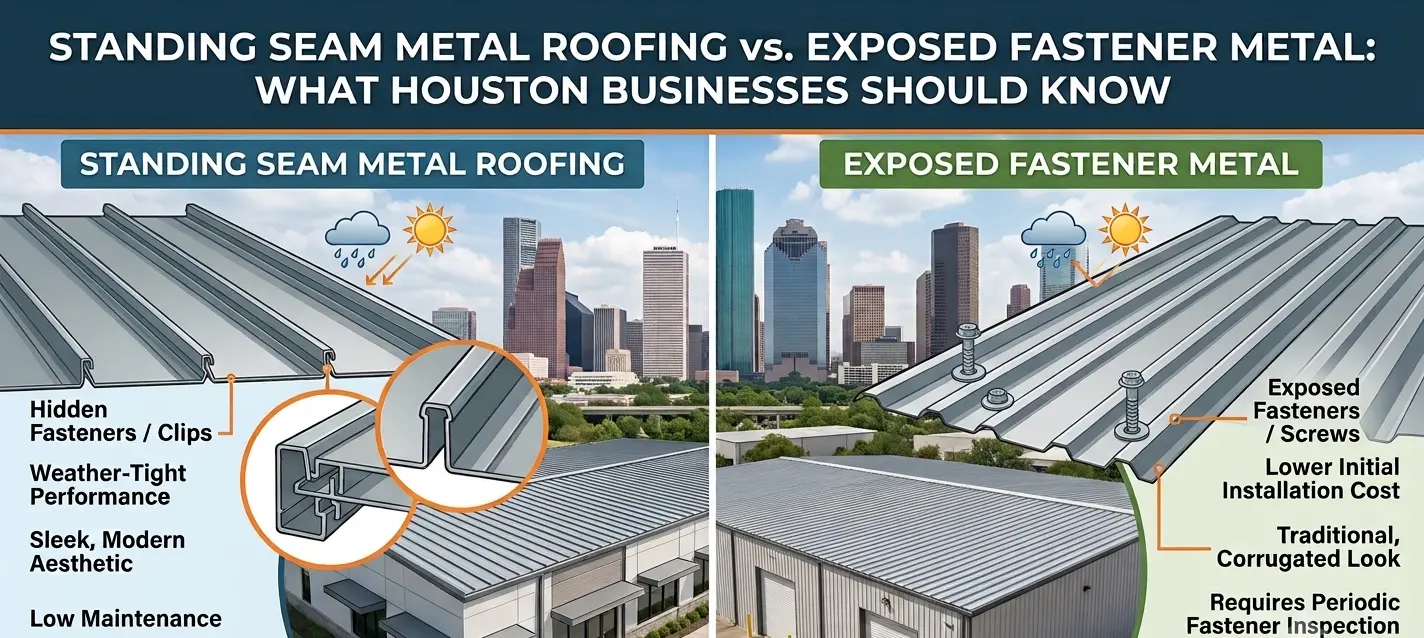

If you are choosing between a standing seam vs exposed fastener metal roof, Houston businesses need to get this decision right the first time. Every year, commercial roofing Houston property owners waste thousands of dollars picking the wrong metal panel system for their building type and budget. The wrong choice costs you in repairs, rising energy bills, and premature replacement. Standing seam outperforms exposed fastener metal on leak resistance, wind uplift, thermal movement, and long-term ROI. But exposed fastener panels still serve a legitimate purpose on the right project.
This guide gives you a complete, honest comparison so you can make the right call for your commercial property.
Standing Seam vs Exposed Fastener Metal Roof Houston: Key Differences Explained
These two systems look similar from a distance. Up close, they work in opposite ways.
- Standing seam uses vertical panels that run from the ridge to the eave. Hidden clips lock each panel from underneath. No fastener ever touches the exposed roof surface. The raised seams interlock to create a continuous, weathertight barrier.
- Exposed fastener metal, also called R-panel or PBR panel, uses screws driven directly through the face of each panel into the deck or purlins below. A neoprene gasket washer under each screw head creates the seal.
That single difference in attachment method drives every other performance gap between the two systems.
How Each System Handles Houston’s Weather
Houston’s climate is one of the most demanding in North America for commercial roofing. Summer temperatures exceed 100 degrees Fahrenheit regularly. Thermal cycling expands and contracts every panel every day. Humidity accelerates corrosion on any exposed metal component. Hurricane season brings wind gusts that test every fastener and seam connection.
Houston’s combination of blistering heat, sudden storms, and high humidity creates a tough environment for any roof. Your roofing system choice needs to handle every one of these conditions for the next 40 to 50 years.
Leak Risk: The Most Important Performance Gap
This is where the two systems diverge most dramatically. Standing seam commercial roofs are far less likely to leak than exposed fastener roofing because no screws penetrate the panels along vertical seams, and these seams are covered and tightly sealed by the panels.
Every screw on an exposed fastener system is a potential entry point for water. On a 20,000-square-foot exposed fastener roof, you will have 16,000 to 20,000 screws penetrating the panels. On a standing seam roof of the same size, you will have around 6,000 screws, which penetrate only along the eaves, rake edges, horizontal seams, and enclosures.
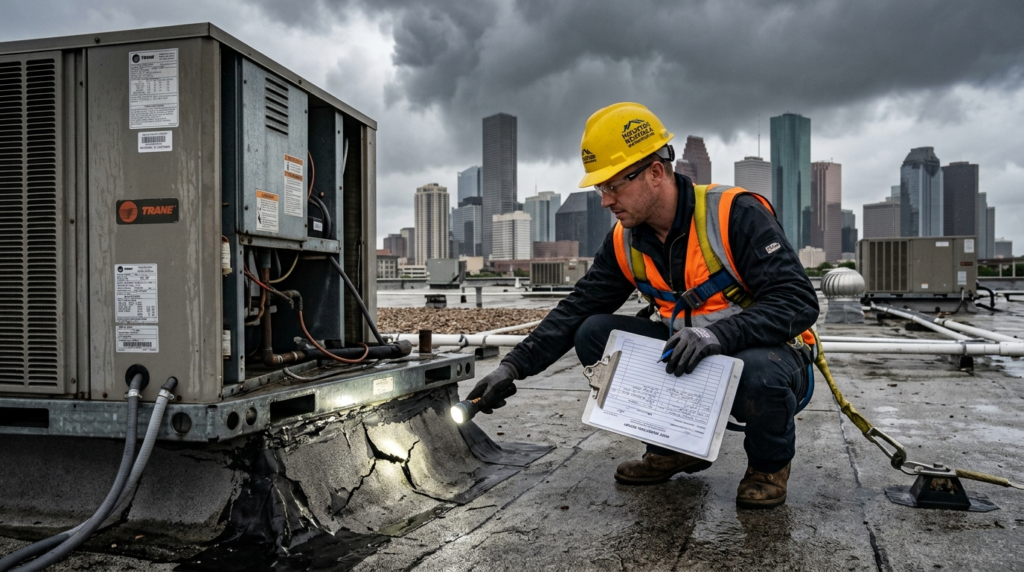
Over 30 years, that difference compounds significantly. Neoprene gaskets degrade over time, especially in climates with intense UV exposure and wide temperature swings. As the gaskets wear, the seals around fastener penetrations can loosen, which allows water infiltration if the roof is not periodically inspected and re-fastened.
Houston’s UV intensity accelerates the gasket degradation faster than most other markets in the country.
Thermal Movement: Why Houston’s Heat Cycle Matters
Metal expands in heat and contracts at night. In Houston, this happens 365 days a year. The concealed fastener system in the standing seam allows panels to expand and contract up to half an inch with temperature changes. Each hidden clip floats independently. The panels move without stressing their attachment points.
On exposed fastener systems, the screws are fixed points. The panels cannot move freely around them. Over years of thermal cycling, this can cause panels to slightly elongate the holes around fasteners, reducing the integrity of the seal.
The standing seam design allows for natural expansion and contraction of the metal without compromising the integrity of the roof. This flexibility prevents fasteners from loosening, which is a common issue with screw-down panels. For Houston businesses running large commercial spans, this matters enormously over a 40-year roof life.
Wind Uplift and Hurricane Performance
Houston is hurricane country. Wind resistance is not a preference here. It is a requirement. Engineered standing seam metal roofing systems typically adhere to testing standards for wind uplift, air leakage, water penetration, fire and combustion resistance, and impact resistance.
Properly installed standing seam carries wind ratings of 140 mph or higher, depending on the panel profile and clip spacing. Exposed fastener systems respond to hurricane conditions differently.
Through-fastened systems rely on exposed screws that penetrate the panel surface, creating potential failure points as thermal cycling causes fastener holes to elongate over time.
For warehouses and storage facilities, exposed fastener panels may be adequate. For client-facing commercial buildings, office parks, medical facilities, and high-value industrial properties in Houston, standing seam is the right choice.
You can learn more about how storm damage affects Houston commercial roofs on our Commercial Roof Repair Houston page.
Energy Efficiency and Cooling Cost Savings

Houston businesses run air conditioning for nearly ten months of the year. Your roof system directly affects the utility cost.
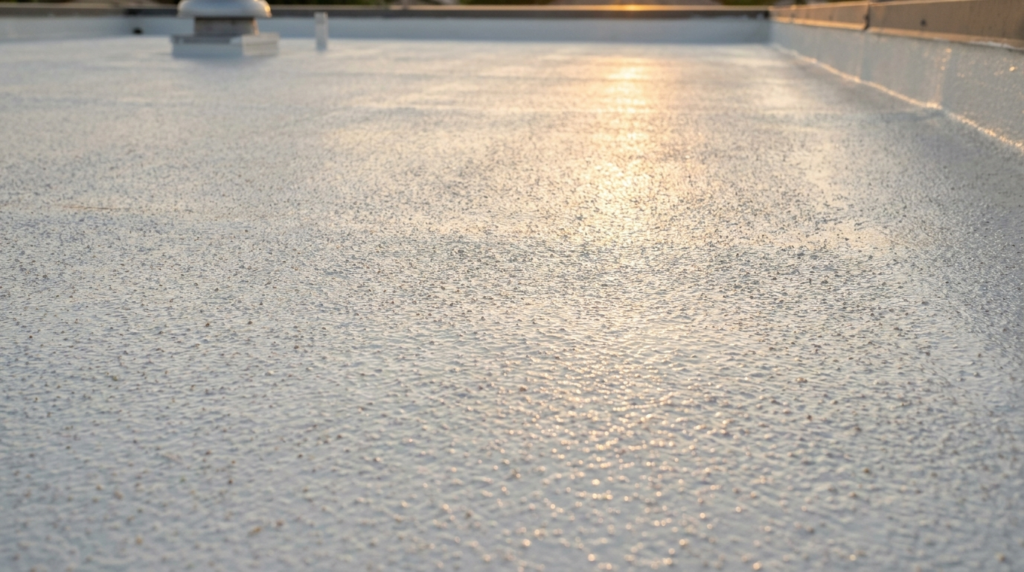
Metal reflects solar heat, keeping attic temperatures lower and reducing energy bills. According to the U.S. Department of Energy, cool roofs like standing seam metal can reduce peak cooling demand by 10 to 15 percent.
Standing seam panels typically carry PVDF paint systems, also known as Kynar 500 coatings. These reflective finishes resist UV degradation and maintain their performance for 35 to 40 years.
The concealed fasteners and uninterrupted surface of the standing seam minimize heat transfer, enhancing the ability to reflect sunlight and reduce indoor cooling demands.
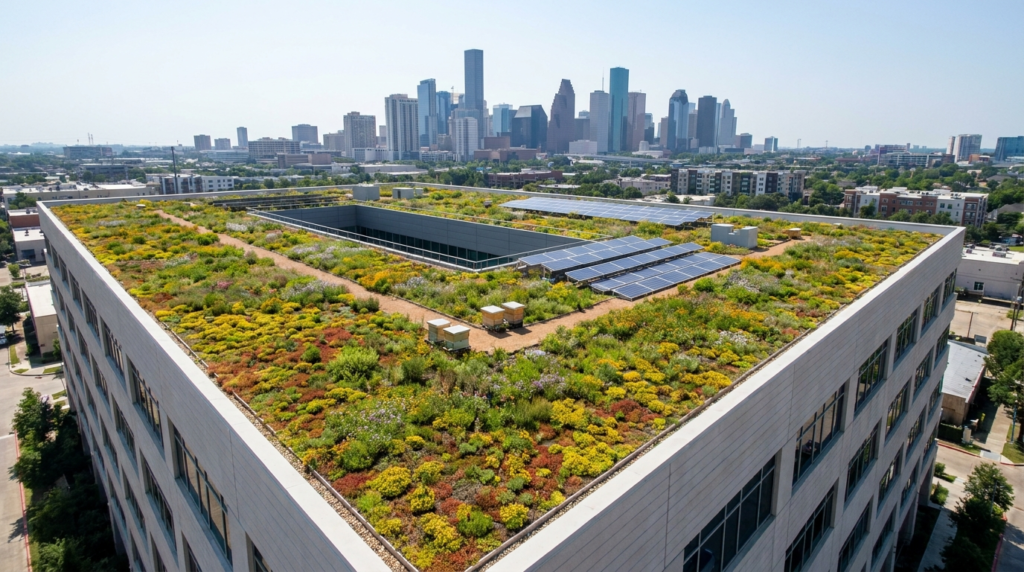
Standing seam systems are particularly well-suited for integrating solar panels, as the clamping systems for solar arrays attach directly to the seams without penetrating the roof surface, preserving its integrity and warranty.
This makes standing seam a smarter long-term investment for any Houston business considering solar energy now or in the future.
Upfront Cost vs Total Cost of Ownership
Exposed fastener systems cost less to install. That is a real advantage for the right project.
Initial installation costs for standing seam roofs typically range from $600 to $1,400 per square, while exposed fastener roofs usually cost between $4.50 to $5.50 per square foot. However, the total cost of ownership tells a different story.
A standing-seam roof that lasts 50 years with minimal maintenance often delivers a lower cost per year than an exposed-fastener system that is replaced at the 25-year mark. Add HVAC savings from improved reflectivity, reduced maintenance visits, and fewer emergency repairs, and the lifecycle math clearly shifts toward standing seam.
If your commercial property has reached the point where repair costs outweigh the value of the existing system, our Commercial Roof Replacement Houston page outlines when a full system change makes more financial sense.
Panel Systems and Material Specifications
Understanding the specific panels helps you ask better questions when getting bids.
Standing Seam Panel Options
Snap-lock panels connect by clicking together over a hidden clip. They are fast to install and work well on standard commercial pitches.
Mechanical seam panels are crimped with a specialized machine after installation. They are the right choice for low-slope commercial roofs and large industrial spans.
Panels are typically made from 24-gauge Galvalume steel or aluminum. Galvalume steel provides excellent corrosion resistance for most Houston locations.
For buildings within a few miles of the Texas coast, aluminum is the right material regardless of cost. Aluminum does not corrode in salt air the way steel does, even Galvalume-coated steel.
Exposed Fastener Panel Options
R-panel and PBR panels are the standard systems for commercial and industrial buildings. They are strong, widely available, and straightforward to install.
R-panel and PBR systems are cost-effective exposed fastener panels ideal for warehouses, industrial buildings, and agricultural structures.
Corrugated metal panels are also an exposed fastener system. They suit agricultural buildings and projects where budget is the controlling factor.
Which System Is Right for Your Houston Building?
Use this as your decision guide.
Choose standing seam metal roofing when:
Your building is client-facing or professionally branded. Hurricane wind resistance is a priority. Your roof has a low slope where water shedding is critical. You want future solar panel integration without roof penetrations. You plan to own the property for 20 or more years. Your building houses equipment, inventory, or operations that cannot tolerate leaks.
Choose exposed fastener metal roofing when:
The building is a warehouse, agricultural structure, or storage facility. Budget is the controlling factor on a functional, non-client-facing building. The project timeline is urgent. The building has a steep enough pitch to shed water effectively without sealed seams. And if your building has a flat or low-slope roof instead, a 60-mil TPO membrane is often the smarter budget-friendly alternative worth considering.
Industry experts consistently recommend standing seam metal roofing for projects prioritizing long-term performance, weather protection, and architectural appeal. The concealed fastener system addresses the fundamental weakness of exposed penetrations while providing thermal movement accommodation that prevents fastener fatigue.
Installation Standards and Contractor Qualifications
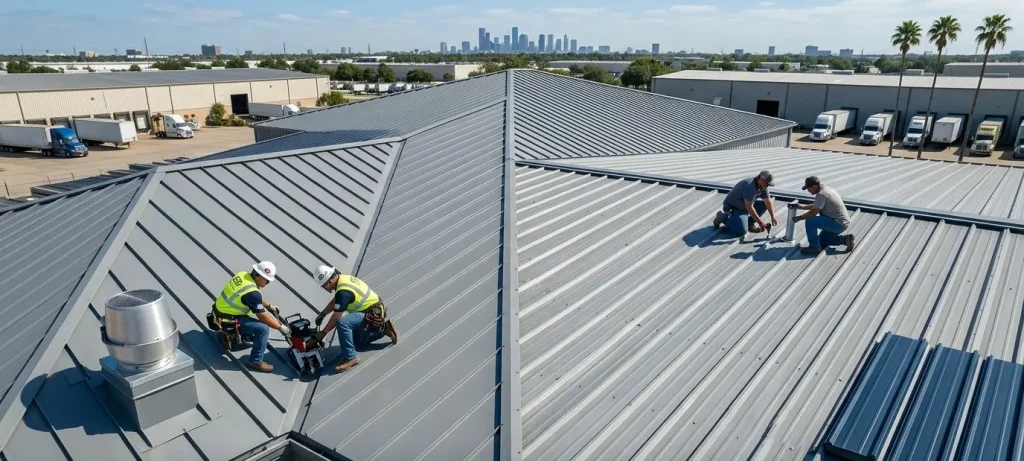
Standing seam installation requires genuine expertise. Most general roofing crews cannot do this work correctly. Panel cutting, flashing fabrication, clip installation, thermal expansion management, seaming, and the detail work around valleys, hips, and penetrations all require experienced metal roofers. A shingle crew cannot do this work properly.
When evaluating commercial metal roofing contractors in Houston, ask for the following:
- Manufacturer certification for the specific panel system. Experience with mechanical seam systems if your roof is low-slope. References from commercial projects of similar scale. Written warranty documentation from both the manufacturer and the installer.
- Exposed fastener systems have broader contractor availability. Most experienced commercial roofers can install R-panel and PBR panels competently. This wider availability keeps installation costs lower and timelines shorter.
FAQs
Can I install new metal roofing over my existing roof?
Yes, in most cases. Metal retrofit systems allow new panels over existing roofing, eliminating tear-off costs and reducing timelines. A structural assessment is required first to confirm that the deck can support the added load.
How does exposed fastener metal perform during Houston hurricanes?
It holds up adequately on lower-slope agricultural and industrial buildings. However, thermal cycling causes fastener holes to elongate over the years, reducing wind resistance on older systems. Standing seam consistently carries higher wind uplift ratings and performs better in post-hurricane damage assessments.
What slope do I need for a standing seam?
Mechanical seam standing seam panels work on pitches as low as 0.5/12, making them suitable for nearly flat commercial roofs. Snap-lock systems require a minimum pitch of 1/12 to 2/12, depending on the manufacturer’s specification.
What gauge steel should I specify for a Houston commercial building?
For standing seam, specify 24-gauge as the minimum on commercial projects. For exposed fastener systems, 26-gauge is standard. Thicker gauge improves wind resistance, dent resistance, and long-term durability under Houston’s thermal stress.
Does standing seam metal roofing qualify for energy incentives in Texas?
Federal energy efficiency incentives may apply to cool metal roofing installations. Consult a tax professional with your specific panel specifications and building location to confirm current eligibility under available programs.
How much does commercial standing seam metal roofing cost in Houston?
Costs vary based on roof size, complexity, panel gauge, and paint system. Standing seam runs higher per square than exposed fastener systems upfront. However, across a 40 to 50-year service life with lower maintenance costs and energy savings, the total cost of ownership is often competitive or superior.
Conclusion
For most Houston commercial property owners, the standing seam vs exposed fastener metal roof Houston decision comes down to one question: how long do you plan to hold this building?
If the answer is 15 years or more, standing seam metal roofing is almost always the better investment. It seals better, handles Houston’s heat and hurricane winds more effectively, lasts longer, and protects the building asset you have invested in.
We serve businesses across Greater Houston, including Downtown, the Energy Corridor, the Galleria, Katy, Sugar Land, Cypress, Pasadena, and The Woodlands. Check our Service Areas page to confirm coverage for your location.
Ready to get an honest assessment of your building? Contact us today for a free inspection and written estimate. No pressure, no runaround, just a clear recommendation from a team that knows Houston commercial roofing.